Over two years ago, we introduced the idea of Operations-Enabled Growth—the belief that sustainable growth depends on more than great campaigns, technology, or strategy. It requires the operational foundation to connect them all.
A lot has changed since then.
AI has moved from experimentation to expectation, reshaping how B2B organizations think about productivity, customer experience, content, data, and, of course, growth.
And the pressure is coming from every direction. CEOs want productivity. Boards want efficiency. Sales wants better signals. Marketing wants more personalization. And every team is trying to figure out how AI can help them move faster and do more with the resources they already have.
But there’s a problem.
AI doesn’t operate in a vacuum. And it can’t fix a broken process.
70% of CMOs say becoming a leader in AI is a critical goal for 2026 — but only 30% believe their organization has the infrastructure to get there.
— Gartner, 2026 CMO Spend Survey
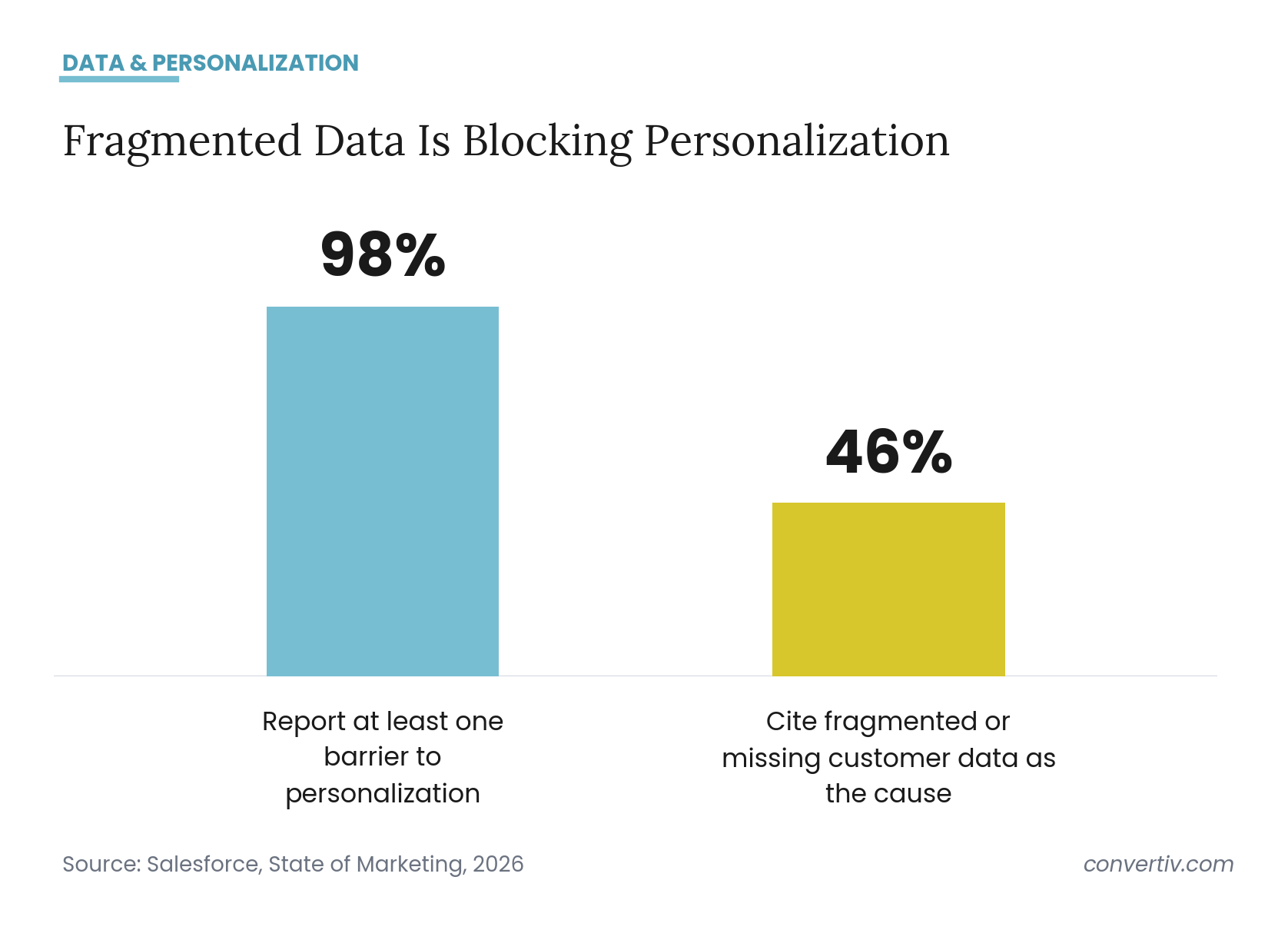
An AI model can’t magically reconcile conflicting definitions buried across your CRM and data stack. Personalization doesn’t work when customer data is fragmented. And generating content faster doesn’t create growth if it still takes three weeks to get a campaign live.
AI amplifies the systems around it—both their strengths and their weaknesses.
That’s why the next phase of AI transformation isn’t about simply adopting more models, agents, or tools.
It’s about building a go-to-market operating model that can actually put AI to work.
We call that AI-Enabled GTM.
AI-Enabled GTM: What Is It?
AI-Enabled GTM is an operating model designed to help established organizations apply the speed and leverage of AI to their scale, data, technology, and customer relationships.
Because enterprise organizations don’t need to become AI startups.
They need to remove the friction that prevents them from using their existing scale at the speed of AI.
AI-native companies, regardless of size, often have an inherent advantage. They were built in an environment where AI can be embedded into workflows from day one. They tend to have fewer legacy systems, less technical debt, smaller teams, and fewer organizational dependencies. They can experiment, learn, and adapt quickly.
Established enterprises are playing a different game.
They have complex technology environments. Years of processes, customer data, governance requirements, and organizational dependencies. Systems have accumulated over time. A seemingly simple change to a campaign, website, workflow, or customer experience can touch multiple platforms, teams, and stakeholders.
But those enterprises also have something an AI-native startup can’t manufacture overnight: established brands, long-term customer relationships, rich proprietary data, significant resources, and scale.
Those aren’t liabilities. They’re advantages.
The goal isn’t to strip all of that away in pursuit of startup-like simplicity.
It’s to make those advantages move faster.
That is the promise of AI-Enabled GTM: connecting the data, technology, workflows, and experiences required for AI to work across the GTM organization—not as another collection of disconnected tools, but as part of how the business actually operates.
And when that happens, the impact goes well beyond productivity.
Organizations can:
- Move from idea to market faster. Reduce the handoffs, manual work, and technical bottlenecks that slow campaigns and digital experiences.
- Turn fragmented data into usable intelligence. Give teams and AI systems the trusted context they need to identify opportunities, surface signals, and make better decisions.
- Personalize at enterprise scale. Move beyond static segmentation toward experiences that respond to customer behavior, intent, account context, and lifecycle stage.
- Create a more responsive GTM engine. Connect insights, content, campaigns, sales activity, and customer experiences so the organization can adapt faster as markets and buyers change.
- Get more value from the technology already in place. Instead of continually adding tools, make existing platforms, data, and workflows work together more effectively.
- Increase capacity without increasing complexity. Automate repetitive work and compress workflows so teams can move faster and produce more without requiring headcount, technology spend, and operational complexity to grow at the same rate.
The goal isn’t simply to become a company that uses AI.
It’s to become an organization where AI can actually do useful work—because the data is trusted, the systems are connected, the workflows are ready, and the people around them can act on what AI produces.
That’s the difference between AI ambition and AI-Enabled Growth.